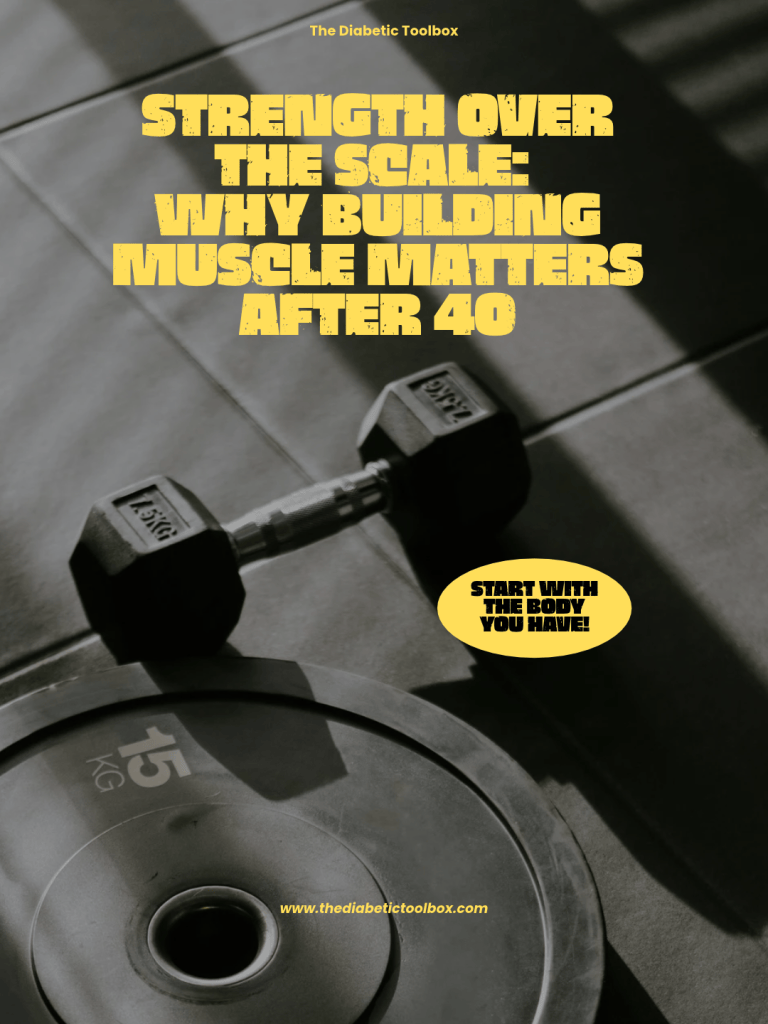
Hello, my friend, and welcome to The Diabetic Toolbox, where we are on a mission to end Type 2 diabetes, one family at a time, through education, support, and empowerment. If this is our first time meeting, my name is Renee. I am an emotional eating and diabetes lifestyle coach and yoga teacher. Today we are talking about something I think deserves far more attention, especially for those of us over 40 who are trying to lose weight, manage our blood sugar, and stay active as we get older: strength.
One thing I missed during my wellness hiatus was weight training. There is something cathartic about lifting a weight and pushing your body to do just one more rep when you feel like giving up. It is also satisfying to see the muscle definition that represents all that hard work. But when I returned to weight training, much of my muscle definition was gone, and so was some of the strength I had worked so hard to build. I was starting over with my 8-pound dumbbells, and that first workout was not pretty. Before my break, I had worked my way up to 10 to 12 repetitions using 15- and 17.5-pound dumbbells for some exercises. Now, three sets of eight repetitions with an 8-pound dumbbell had my biceps feeling like they were going to burst. Oh, the burn.
But something happened during that workout that mattered more than how much weight I could lift. I felt that familiar sense of satisfaction again. My muscles were working. I was challenging myself. I finished what I started. And somewhere between those first shaky repetitions and putting the dumbbells down, I knew I was going to be all right. I didn’t have to lift what I used to lift. I simply had to begin rebuilding from where I was today.
Why Strength Matters More Than the Number on the Scale
We spend so much time talking about weight after 40 that we can forget to ask another important question: How strong am I? Muscle matters as we age. Strength training helps us maintain muscle and physical function, supports our bones, and makes everyday activities easier. It can help us keep doing the things we often take for granted, such as getting out of a chair, carrying groceries, climbing stairs, getting up from the floor, traveling, gardening, and moving through life with greater confidence.
If you are living with prediabetes or Type 2 diabetes, there is another reason to pay attention to your muscles. Your muscles are an important place where your body stores and uses glucose. During and after physical activity, working muscles can take up more glucose, and regular resistance training can improve insulin sensitivity. That means the dumbbells sitting in the corner aren’t just about creating more defined arms. They can be part of your blood sugar management strategy.
This is one reason I want us to stop letting the scale be the only measure of whether our wellness efforts are working. You can get stronger, move better, increase your endurance, preserve muscle, improve how your clothes fit, and improve your metabolic health even when the scale isn’t giving you the applause you think you deserve. Sometimes the victory isn’t losing another pound; it’s picking up the heavier dumbbell.
Three Practical Tips for Getting Started with Weight Training
1. Start with the Body You Have Today
This was the lesson I had to learn when I returned to lifting. My mind remembered the 15- and 17.5-pound dumbbells. My body said, “Girl, we’re using the eights today.” And the eights counted.
One of the easiest ways to become discouraged is to compare your current strength with what you could do six months, five years, or twenty years ago. Your starting point is simply information. Choose a resistance that lets you perform the exercise with good form while still feeling challenged by the end of your set.
There is no shame in starting light.
- Eight pounds isn’t failure.
- Five pounds isn’t failure.
- Body weight isn’t failure.
- Modification isn’t failure.
The goal is to give your muscles an appropriate challenge and gradually build from there.
2. Train Your Whole Body
You don’t need a complicated collection of exercises to begin strength training. A simple routine that works the major muscle groups can give you a solid foundation. Here is the full-body routine I am using as I rebuild my strength:
Biceps curls
Keep your elbows close to your sides and curl the dumbbells toward your shoulders.
Triceps extensions
Use a comfortable range of motion and control the weight throughout the movement.
Shoulder presses or shrugs
If overhead movements aren’t comfortable for your shoulders, substitute shrugs or another shoulder-friendly movement recommended by your healthcare or fitness professional. I modify overhead work myself when my shoulder needs it.
Chest presses
These can be performed with dumbbells while lying on a bench or another stable surface appropriate for the exercise.
Gorilla rows
Rows strengthen the back and help build the pulling strength we use in everyday life.
Squats
Use body weight, a chair, or added resistance depending on your current strength, balance, knees, and mobility.
Calf raises
Hold onto a stable surface if needed and slowly raise and lower your heels.
Knee lifts
These can help work the hips and core while also challenging balance. Hold onto something stable when necessary.
You don’t have to perform every exercise perfectly or use heavy weights. Start with movements you can perform safely and build from there. If an exercise causes pain rather than normal muscular effort, stop and find an appropriate modification.
3. Track Strength Victories That Have Nothing to Do with Weight Loss
This is where I think we need to change the conversation. Keep the scale if you want it. But don’t let it be your only scoreboard. Pay attention to what happens when eight repetitions become ten. Notice when you can carry your groceries without putting the bags down. Celebrate when you move from an 8-pound dumbbell to a 10-pound dumbbell. Notice when getting out of a chair becomes easier. Pay attention when you can walk farther, climb stairs more comfortably, or finish a workout that once exhausted you. Those are not consolation prizes. Those are results.
One Action to Take Today
Here’s your assignment for today, and it is simple.
Choose one strength exercise. That’s it. You could do bicep curls, calf raises, chair squats, chest presses, rows, or another movement that works for you. Start with a manageable amount of resistance and perform a small number of controlled repetitions.
Don’t worry about creating the perfect workout plan today, or about what you could lift ten years ago. Establish your starting point. Write down the exercise, the weight or resistance you used, and the number of repetitions you completed. Then you have something incredibly useful: a baseline. A few weeks from now, you can look back and see what your body has learned.
Small Strength Victories Add Up
When I finished that first workout with my 8-pound dumbbells, I could have focused on everything I had lost. I could have been frustrated that the weights I used to lift felt too heavy. I could have compared myself with the woman I was before my wellness hiatus. The thoughts did cross my mind. Instead, I realized something. I picked the weights back up.
That was the victory. And if you are starting over right now, I want you to remember that. Your first workout back doesn’t have to prove how strong you once were. It establishes where you’re beginning now. You can rebuild your strength one repetition at a time. One set at a time. One workout at a time. And eventually, you may notice something much more important than a smaller number on the scale. You are stronger.
Ready to Build Walking and Strength into Your Routine?
Thank you so much for spending a few minutes with me today. Please share this post with someone you love. And let us know in the comments: What is one small strength victory you are proud of, or what strength exercise are you committing to starting this week?
Where could your blood sugar be in 30 days?
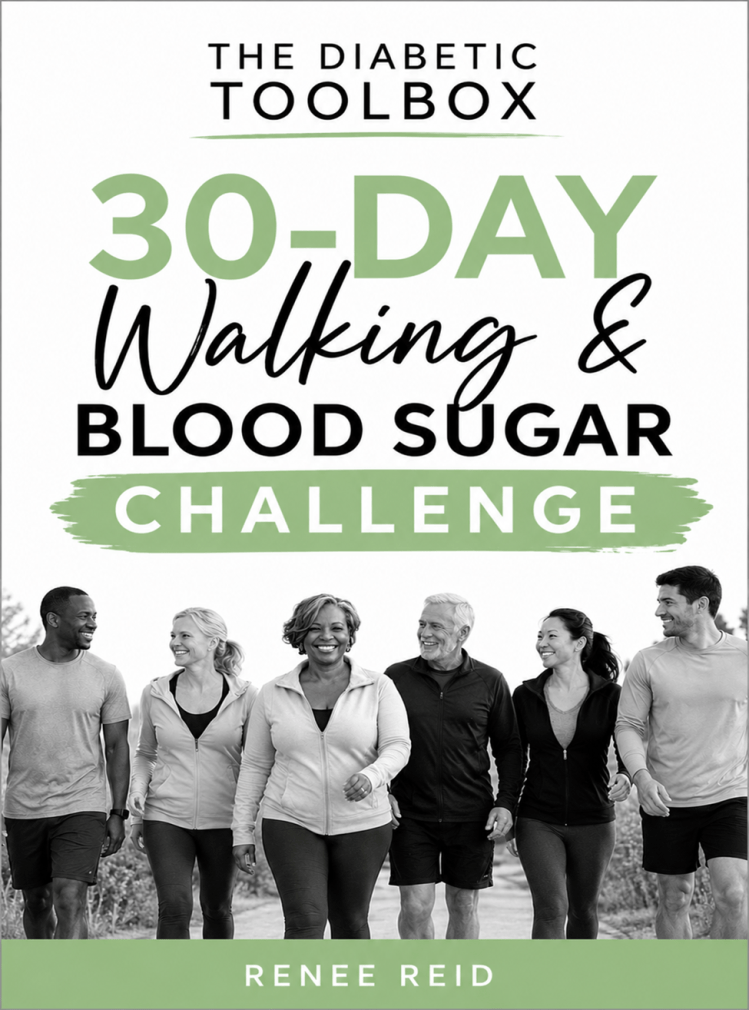
If you are ready to take the next step, join my 30-Day Walking & Blood Sugar Challenge. Inside, you’ll receive a progressive walking plan, a 14-day Mediterranean-style meal plan, pre- and post-walk stretches, my weight-training guide, private community support, and direct access to me for encouragement along the way.
Join the 30-Day Walking & Blood Sugar Challenge here: https://payhip.com/b/CBTkW
Walking can help you get moving. Strength training can help you build the body that supports that movement. Together, they can become part of a sustainable approach to improving your fitness and supporting healthier blood sugar.
Remember, change happens one habit, one choice, one day at a time.
Until next time, take care of yourself and each other.
With Peace & Love,
Renee
Disclaimer: The Diabetic Toolbox content is for informational and educational purposes only and is not a substitute for professional medical advice, diagnosis, or treatment. Always consult your licensed healthcare provider before changing your diet, medication, or fitness routine. Participation in any exercise or wellness program is at your own risk. Your health and safety are our top priorities, and we’re honored to walk this journey with you.

