Hello, my friend, and welcome to The Diabetic Toolbox, where we are on a mission to end Type 2 diabetes, one family at a time, through education, support, and empowerment. If this is our first time meeting, my name is Renee. I am an emotional eating and diabetes lifestyle coach and yoga teacher. Today, we are talking about stress and why I believe it deserves a much bigger place in our conversations about blood sugar management. Be sure to check out part two of the stress series tomorrow.
When we want to lose weight, lower our blood sugar, increase our mobility, and feel more confident about our health markers at our next checkup, we tend to jump straight to food and exercise. What are you eating? How many carbohydrates are you having? Are you walking? Are you strength training? Those things absolutely matter. But what about the stress you’re carrying around every single day? What about lying in bed exhausted while your mind refuses to turn off? What about waking up already feeling drained?
What about reaching for something salty or sweet when you’re overwhelmed, or needing that big cup of coffee with plenty of cream and sugar just to convince yourself that you can make it through another morning? Well, maybe that’s just me, but I don’t think so, my friend. Sometimes we are concentrating so much on changing what is on our plate that we never stop to ask what is happening in our lives.
Stress Can Affect More Than Your Mood
That fight-or-flight feeling is part of your body’s natural response to stress. Your body releases stress hormones, including cortisol and adrenaline, which help make more energy available when your brain believes you need to respond to a threat. That response is useful when you actually need it. The problem is that modern stress doesn’t always disappear quickly.
Financial worries, family responsibilities, work, caregiving, poor sleep, relationship problems, health concerns, and simply trying to keep up with everything can leave us feeling like we’re constantly switched on. Stress hormones can affect blood glucose, and stress can also influence the behaviors that help us manage it.
Think about what happens after a terrible night’s sleep. Are you excited to get up and take a walk, or are you trying to find enough energy to get through the morning? After an emotionally exhausting day, are you thinking about preparing a balanced dinner, or does that bag of chips suddenly look very appealing? Stress management isn’t a replacement for nutritious food, movement, sleep, prescribed medication, or working with your healthcare provider. It is another part of the picture. I like to think of it as another tool in your Diabetic Toolbox.
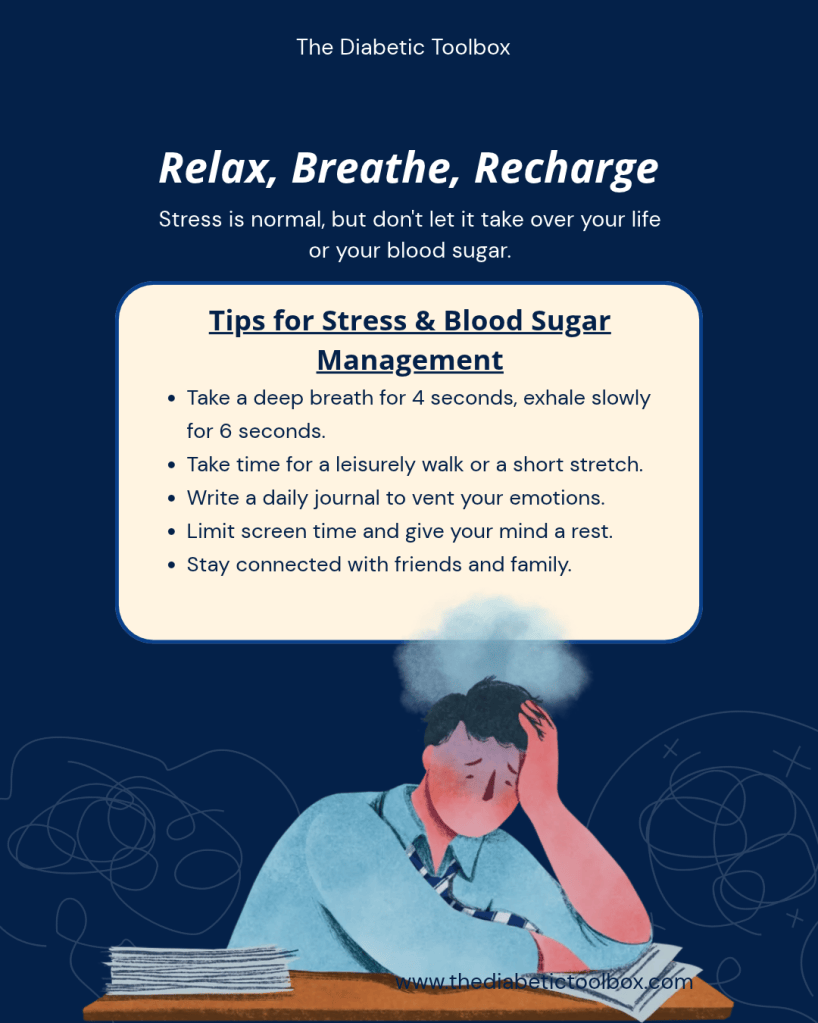
Managing your blood sugar isn’t only about asking, “What should I stop eating?” We also need to ask, “What is stressing me out, how is my body responding to it, and what can I do today to help myself feel a little more settled?” That might mean taking five slow breaths before eating, stepping outside for ten minutes, turning your phone off before bed, stretching, praying, journaling, saying no to something you genuinely don’t have the capacity to do, or taking a short walk after dinner. The remedy to your stress is in your hands.
Start With One Thing You Can Do Today
This is also why I want us to stop thinking that improving our health requires changing everything at once. I know you might be tired of me saying that, but you don’t have to overhaul your entire diet, exercise for an hour every day, give up every food you enjoy, or somehow eliminate every stressful situation from your life; first of all, that will never happen. So, start with something you can actually repeat. A ten-minute walk is one of my favorite places to start because it lets you move your body, step away from whatever has been demanding your attention, and create a small period of time that belongs to you.
If you want help building that into a consistent routine, my 30-Day Walking & Blood Sugar Challenge gives you a progressive walking plan, plus meal support, stretching, strength-training guidance, community, and access to me for encouragement along the way.
And if you still think you have to turn your entire life upside down to improve your health, I created this to help you separate what deserves your attention from the pressure we put on ourselves when we’re trying to get healthier. Thank you so much for spending a few minutes with me today. Let us know in the comments: When you’re under a lot of stress, what do you notice first? Does it affect your sleep, your eating, your energy, your movement, or something else?

Take the Next Step
Where could your blood sugar be in 30 days? Ready to take the next step? Join my 30-Day Walking & Blood Sugar Challenge. Inside, you’ll receive a progressive walking plan, a 14-day Mediterranean-style meal plan, pre- and post-walk stretches, my weight-training guide, private community support, and direct access to me for encouragement along the way.
Click here to join the 30-Day Walking & Blood Sugar Challenge.
Remember, change happens one habit, one choice, one day at a time.
Until next time, take care of yourself and each other.
With Peace & Love,
Renee
More Resources From The Diabetic Toolbox
The Diabetic Toolbox Podcast
Prefer to listen? Join Renee on The Diabetic Toolbox Podcast for practical, honest conversations about managing prediabetes and type 2 diabetes in everyday life. Each episode explores topics such as blood sugar management, emotional eating, movement, healthy habits, weight loss, mobility, and creating a lifestyle that supports your health without resorting to extreme diets or hours in the gym. Explore previous episodes wherever you listen to podcasts.
Reference Guide: Starting Your Movement Plan
Want something you can save and use when you’re ready to exercise? Download the companion reference guide, Starting Your Movement Plan: Yes, It Might Hurt, But This Will Help. This simple guide gives you practical reminders for preparing your body before movement, paying attention to how you feel while exercising, caring for your body afterward, and choosing an appropriate place to begin.
Renee & Ruby’s
Renee & Ruby’s was created in honor of my mother, Ruby, whose experience with type 2 diabetes remains central to The Diabetic Toolbox’s mission. Visit the shop to discover apparel, mugs, journals, totes, and other products designed to celebrate strength, encouragement, and the women we love. Your purchases also help support our work serving people and families affected by prediabetes and type 2 diabetes.
Disclaimer
The Diabetic Toolbox content is for informational and educational purposes only and is not a substitute for professional medical advice, diagnosis, or treatment. Always consult your licensed healthcare provider before changing your diet, medication, or fitness routine. Participation in any program, including our Yoga Audio Series, is at your own risk. Your health and safety are our top priorities, and we’re honored to walk this journey with you.

