Before my yoga training, and before I really started studying movement, I thought flexibility simply meant being able to touch your toes or bend yourself into some impressive yoga pose. I thought mobility and flexibility were basically the same thing, and I certainly wasn’t thinking about either one as something that could affect how independently I lived as I got older. I literally thought Mobility and Flexibility Were Basically the Same Thing
I am always looking for ways to expand my knowledge. It is the teacher and researcher in me. When I learn something that can help us take better care of ourselves, I want to come right back here and share it with you.
And today’s topic actually came from a longtime listener and participant in my 30-Day Walking & Blood Sugar Challenge. She is a 70-year-old grandmother who wants to stay active, continue taking care of herself independently for as long as possible, and travel without arthritis deciding what she can and cannot do. After one of her walks, she asked whether the exercises she did afterward counted as mobility training or flexibility work.
It was such a good question because we often use those two words interchangeably. But mobility and flexibility aren’t the same, and understanding the difference can help us build a more complete wellness routine. I can certainly relate to why she asked. My son is planning a trip to Vietnam for his 40th birthday, and when I think about that trip, I don’t just think about getting on an airplane and taking beautiful family pictures.
I think about walking. The stairs, getting in and out of cars, standing, sightseeing with the rest of the group, getting up the next morning and doing it all again. And I don’t want to be stuck in a hotel room nursing knee pain while my family explores the city. That is why mobility has become about much more than exercise for me. I want my body to keep letting me participate in my life.
Hello, my friend, and welcome to The Diabetic Toolbox, where we are on a mission to end Type 2 diabetes, one family at a time, through education, support, and empowerment. If this is our first time meeting, my name is Renee. I am an Emotional Eating and Diabetes Lifestyle Coach and Yoga Teacher.
Today we are talking about the difference between mobility and flexibility, why both deserve a place in your wellness routine when you are managing prediabetes or Type 2 diabetes, how to work on them without adding another hour-long workout to your day, and a simple routine you can try today.
First, What Is the Difference Between Mobility and Flexibility?
Let’s keep this simple. Flexibility is your body’s ability to lengthen muscles and related tissues through a range of motion. Think about sitting on the floor with your legs extended and gently reaching toward your toes. You may feel a stretch through the backs of your legs. That is flexibility work.
Mobility is your ability to actively control movement through a joint’s available range of motion.
Think about standing and slowly lifting your knee toward your chest without pulling it up with your hands. Your hip has to move, but your muscles also have to control that movement. That is mobility. Another easy example is your shoulders.
If you use one hand to pull the opposite arm across your chest and hold it there, you’re primarily stretching. If you slowly circle your arm forward and backward under your own control, you’re working on movement at the shoulder joint. Both have value. But they aren’t interchangeable.
Why Does This Matter When You’re Managing Your Blood Sugar?
Here’s where I want to be careful because I don’t want to give mobility and flexibility exercises credit for something they aren’t doing. Stretching your hamstrings for 30 seconds isn’t a substitute for your walking program, strength training, nutrition, prescribed medication, sleep, stress management, or the other parts of your diabetes care plan. But mobility and flexibility can support something incredibly important: Your ability to keep moving.
Think about it. If your ankles feel stiff, walking can become uncomfortable. If your hips don’t move well, your stride can change. If your knees hurt every time you get up from a chair, you may start avoiding unnecessary movement. If bending, reaching, turning, and getting down to the floor become increasingly difficult, you may naturally start doing less.
And when you’re trying to manage your blood sugar, regular physical activity matters. So I want you to think of mobility and flexibility as part of the support system around your movement habit. We aren’t stretching because stretching is going to magically lower our A1C.
We’re working on our movement because we want our bodies to be capable of walking, strength training, climbing stairs, carrying groceries, traveling, playing with grandchildren, and doing the everyday activities that keep us active. That matters.
Practical Tip #1: Work on Mobility Before You Walk
You don’t need a separate 45-minute mobility class before going for a walk. Give yourself three to five minutes. Before walking, think about movements that gently prepare the joints you’re about to use.
- Try ankle circles.
- March gently in place.
- Make controlled hip circles.
- Bend and straighten your knees within a comfortable range.
- Roll your shoulders.
- Gently turn your upper body from side to side.
These are movements, rather than long-held stretches. You’re essentially telling your body, “We’re about to move. Let’s get ready.” This can be especially useful if you’ve been sitting for several hours before your walk or if you tend to feel stiff when you first get moving.
Practical Tip #2: Save Gentle Flexibility Work for After Your Walk
After your walk, your body is already warm, so it’s a comfortable time to add a few gentle stretches. You don’t need 20 different stretches. Pick a few areas that tend to feel tight after walking.
- Your calves.
- The backs of your thighs.
- The fronts of your thighs.
- Your hips.
- Your chest and shoulders, especially if you spend a lot of your day sitting at a desk.
- Hold each stretch gently rather than bouncing or forcing yourself deeper into the position.
This isn’t a competition. You aren’t trying to prove that you can touch your toes. The goal is to maintain or gradually improve comfortable movement. Five minutes can be enough to start. Now your 20-minute walk has become a more complete 30-minute movement session without adding another workout somewhere else in your day.
Practical Tip #3: Train for the Life You Actually Want to Live
I saw a version of this hanging in the gym where I work out; it said, “Train for life.” This is the part I think we sometimes miss. Mobility shouldn’t exist only inside an exercise program. Ask yourself: What do I want my body to continue being able to do?
For my 70-year-old challenge participant, part of the answer is traveling and continuing to live independently. For me, Vietnam is one answer. I want to walk through airports, explore cities, climb stairs, get in and out of transportation, spend the day sightseeing with my family, and wake up the next morning and do it again.
Your answer might be different. You might want to garden. Get down on the floor with your grandchildren and get back up again. Carry your own groceries. Walk through a museum. Attend a festival. Take a cruise. Keep living in your own home. Go dancing. The point is that your wellness program should prepare you for your actual life.
That gives mobility and flexibility training a much bigger purpose than simply becoming “more flexible.” We’re protecting our ability to participate.
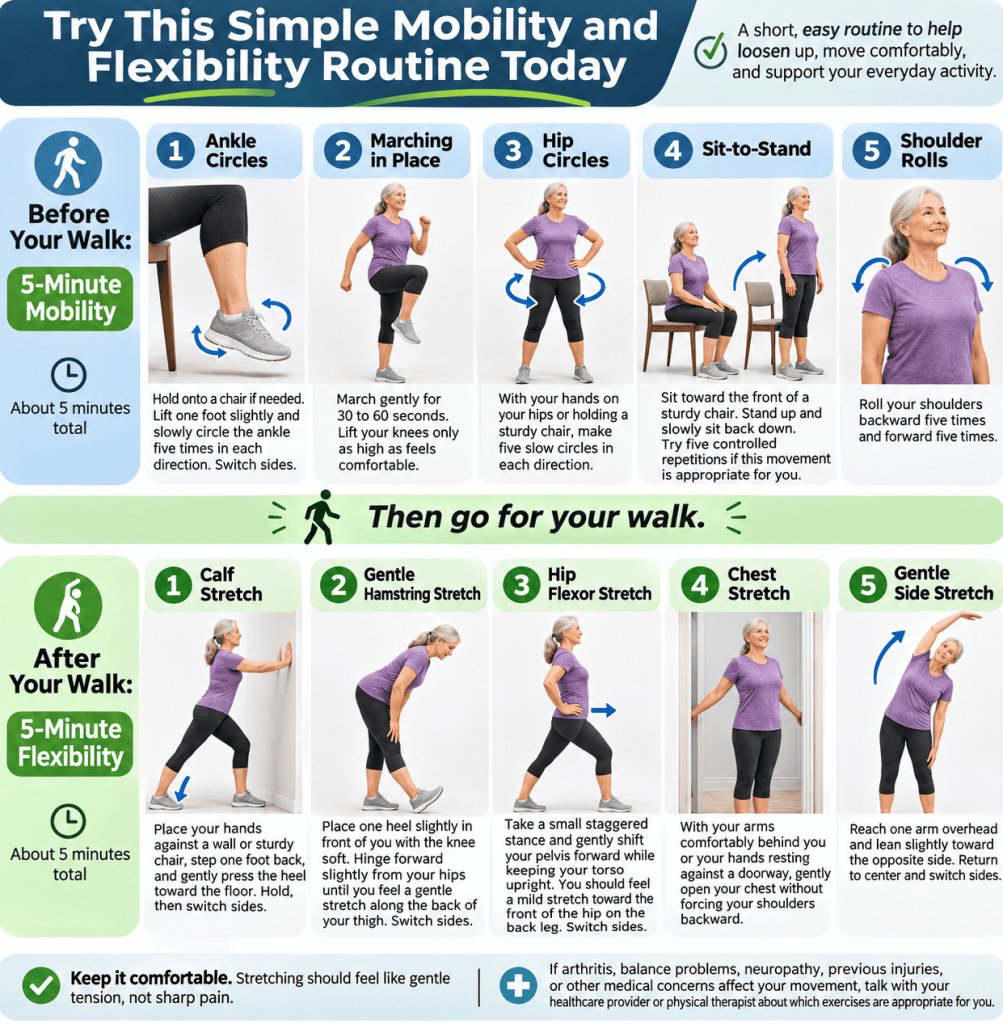
Try This Simple Mobility and Flexibility Routine Today
Here is a short routine you can add to your day. Stay within a comfortable, pain-free range of motion and use a sturdy chair or counter for support when needed.
Before Your Walk: 5-Minute Mobility
1. Ankle Circles
Hold onto a chair if needed. Lift one foot slightly and slowly circle the ankle five times in each direction. Switch sides.
2. Marching in Place
March gently for 30 to 60 seconds. Lift your knees only as high as feels comfortable.
3. Hip Circles
With your hands on your hips or holding a sturdy chair, make five slow circles in each direction.
4. Sit-to-Stand
Sit toward the front of a sturdy chair. Stand up and slowly sit back down. Try five controlled repetitions if this movement is appropriate for you.
5. Shoulder Rolls
Roll your shoulders backward five times and forward five times.
Then go for your walk.
After Your Walk: 5-Minute Flexibility
1. Calf Stretch
Place your hands against a wall or sturdy chair, step one foot back, and gently press the heel toward the floor. Hold, then switch sides.
2. Gentle Hamstring Stretch
Place one heel slightly in front of you with the knee soft. Hinge forward slightly from your hips until you feel a gentle stretch along the back of your thigh. Switch sides.
3. Hip Flexor Stretch
Take a small staggered stance and gently shift your pelvis forward while keeping your torso upright. You should feel a mild stretch toward the front of the hip on the back leg. Switch sides.
4. Chest Stretch
With your arms comfortably behind you or your hands resting against a doorway, gently open your chest without forcing your shoulders backward.
5. Gentle Side Stretch
Reach one arm overhead and lean slightly toward the opposite side. Return to center and switch sides.
Keep the stretches comfortable. Stretching should feel like gentle tension, not sharp pain.
And if arthritis, balance problems, neuropathy, previous injuries, or other medical concerns affect your movement, talk with your healthcare provider or physical therapist about which exercises are appropriate for you.
Your One Action for Today
I don’t want you to finish this article thinking you now need to create another elaborate workout program. I want you to do something much simpler. Before your next walk, spend three to five minutes moving your ankles, knees, hips, and shoulders. Afterward, spend another three to five minutes gently stretching the muscles you just used. That’s it.
Try to do your movement routine as consistently as you can and pay attention to how your body feels.
- Do you feel less stiff when you begin walking?
- Does your stride feel more comfortable?
- Do you feel better afterward?
- Does getting out of the chair later in the evening feel a little easier?
Those are meaningful things to notice.
This Is About More Than Exercise
One thing that has changed for me as I’ve gotten older is how I define fitness. There was a time when I might have focused mainly on how far I could run, how much weight I could lift, or what number appeared on the scale. Those things can still matter. But now I also care deeply about what my body allows me to do.
- Can I get up?
- Can I bend?
- Can I reach?
- Can I walk?
- Can I carry things?
- Can I travel?
- Can I continue taking care of myself?
- Can I say yes when my family says, “We’re going exploring today”?
That is fitness too. And if you are over 40 and managing prediabetes or Type 2 diabetes, I want you to start thinking beyond today’s blood sugar reading. We’re building bodies that we hope will carry us through the next 10, 20, and 30 years. We aren’t trying to become professional athletes. We’re trying to stay in our own lives.
Where Could Your Blood Sugar Be in 30 Days?
If you want to build a walking habit, I’d love to help you get started. Where could your blood sugar be in 30 days? Ready to take the next step? Join my 30-Day Walking & Blood Sugar Challenge.
Inside, you’ll receive a progressive walking plan, a 14-day Mediterranean-style meal plan, pre- and post-walk stretches, my weight-training guide, private community support, and direct access to me for encouragement along the way. Join here: https://payhip.com/b/CBTkW You don’t need another extreme fitness program.
You need a routine that helps you move consistently and supports the life you’re trying to build. Thank you so much for spending a few minutes with me today. Please share this post with someone you love. And let us know in the comments: What is something you want your body to still be able to do 10 years from now?
Remember, change happens one habit, one choice, one day at a time.
Until next time, take care of yourself and each other.
With Peace & Love,
Renee
Disclaimer
The Diabetic Toolbox content is for informational and educational purposes only and is not a substitute for professional medical advice, diagnosis, or treatment. Always consult your licensed healthcare provider before changing your diet, medication, or fitness routine. Participation in any program, including our Yoga Audio Series, is at your own risk. Your health and safety are our top priorities, and we’re honored to walk this journey with you.

